 |
|||
Historical Context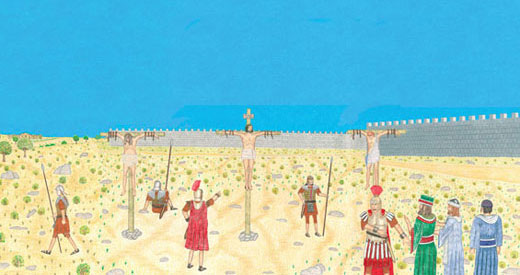
✦ Three primary theories pertaining to the origin of Christianity:
✦ This website presents an alternative theory for the historical Jesus - one that relies more heavily on the character of the early Christian writings presented in Paul's seven letters and the Synoptic Gospels. This alternative theory presumes there are reasonable human explanations behind the character of these early narratives. ✦ Jesus’ ministry began as a collaboration with local Roman authority in Judea under the direction and control of Pontius Pilate. Many biblical scholars generalize Pilate’s character as a typical Roman governor who desired nothing more than to keep the peace. However, we know, even in today’s politics, very powerful men will defy norms and reason to achieve goals not understood by academics. Pontius Pilate could have been such a man with personal goals beyond the norm. He could have had simple desires (naive, ambitious, unreasonable, visionary, disgust with strange beliefs, who knows?) to manipulate the culture of the Jewish people. There are hints from ancient sources that Pilate was cruel and incompetent. However, he reigned as governor for ten years (26 - 36 CE), which suggests some level of competency. He deliberately clashed with Jewish religious doctrine by erecting effigies of Caesar in Jerusalem, but then removed them after fervent protests. Pilate may have desired to improve attitudes of the Judean people to pay taxes, be more acceptant of outside culture, promote submissive behavior, etc. The Roman Prefect before Pilate, Valerius Gratus, appointed and fired a quick succession of five Jewish high priests, but by the time Pilate had become governor, Rome had curtailed this power. Three decades before, during a golden age, Herod the Great was the Roman-appointed “King of the Jews”. Maybe Pilate was pursuing his own dream of Make Judea Great Again. The narratives suggest Pontius Pilate was obsessed with this title. Even Jesus responded, “Thou sayest.”[3] Jesus never referred to himself as “King of the Jews”. Pilate used the title as a type of defense, as in, `Are you sure you want to crucify your king?’[4] In John 19:19, Pilate penned the charge, “King of the Jews” and put it on the cross. The charge is clearly a mockery and spiteful,[5] rather than a serious charge of sedition. Jewish priests took the charge as an insult, since they asked Pilate to change the inscription.[6] However, Pilate responded in what appears to be animosity with, “What I have written I have written.” ✦ In the earliest Christian texts, the Apostle Paul documented a horrible accusation of blanketed blame on the Jews for killing Jesus (1 Thessalonians 2:14-15, c. 50 CE). This is mirrored in the Gospels where Pilate is reluctant to crucify Jesus despite the demands of the Jewish court. The Jewish people saw through Jesus’ teachings as not being divine from their god, and as such, rejected him. ✦ Pontius Pilate may have had curiosity, interest, or sympathy for leaders of a Jewish movement (John the Baptist and, subsequently, Jesus) who were openly and publicly supportive of tax collection for Rome, who had tax collectors as followers, promoted peace, submission to oppression (love your enemies, turn the other cheek, blessed are the peacemakers), criticized Jewish religious orders, never criticized Roman authority, and publicly proclaimed a centurion had the greatest faith in all Israel. ✦ John baptized tax collectors (Luke 3:12-13), told them it was righteous to "collect the appointed amount" and tax collectors were noted as his followers (Matthew 21:32, Luke 7:29). Jesus was a "friend of tax collectors" (Matthew 11:19, Luke 7:34), dined with many (or a large company of) tax collectors (Matthew 9:10, Mark 2:15, Luke 5:29), one of Jesus' disciples was a tax collector (Matthew 9:9-10), Jesus stayed overnight with Jericho's chief tax collector, Zacchaeus (Luke 19:1-7), Jesus instructed Peter to pay the half-shekel tax and not give offense to the collector (Matthew 17:24-27), and "render unto Caesar that which is Caesar's" (Matthew 22:21, Mark 12:17, Luke 20:25). ✦ Like John the Baptist and Jesus, Pontius Pilate was just a man. A man can experience curiosity, interest, or sympathy. However, a current, predominant theory that Pilate had no qualms crucifying Jesus, or did so because he was afraid of a self-proclaimed king being a threat to Rome, is not supported by any early texts (Christian or otherwise). If one presumes that Pontius Pilate may have had curiosity, interest, or sympathy for Jesus, it explains why Pilate would not have let the Sanhedrin stone Jesus. Stoning would have meant an instant and sudden death. Letting the Sanhedrin stone Jesus would have been much simpler for Pilate, if he had no qualms for Jesus' death. Almost everything in the Synoptics - the quick sequence of events with the betrayal and arrest on the same night of the Lord's Supper (multiple attestation in 1 Corinthians 11:23), a personal meeting/trial with Pilate, the odd sequence of the 'crucifixion' (no nails mentioned, removed on the same day per Pilate's authorization, no stabbing in the Synoptics, all Jesus' acquaintances watching the from a distance in the Synoptics, a Roman centurion at the crucifixion site), and guards at the tomb per Pilate's direct involvement, demonstrates that Pilate was in control, and even directing events. Early post writings (Tertullian) support Pilate's complicated involvement, not indifference. ✦ The betrayal and arrest story, as written, was clearly preplanned between Jesus and Judas. A sudden arrest in the middle of the night at a remote location outside the walls of the city, different from the location of the supper meeting (otherwise how would Judas know the odd time and place to bring the hastened arresting party [for formal custody to preempt death plots? - Matthew 12:14 26:4, Mark 3:6 11:18, Luke 19:47 22:2]), initiated by a command from Jesus, "One of you eating with me will [or shall] betray me." It is a type of direction or command, unless you believe in divine preeminence. A formal arrest was a type of protective custody, especially if ending up in Roman custody - again, as written. ✦ The crucifixion described in the Gospel accounts was very unusual, and completely survivable. A Roman centurion declared Jesus’ supposed “death”.[7] Oddly, Pilate was personally involved with directing who could take Jesus from the cross.[8] Jesus appeared live after the crucifixion to his closest followers, causing them to think he had risen from death. This provided the motivation to continue a movement which, unknown to them, was simply a misunderstood Roman interference in local justice, growing into something far beyond anyone's dreams. ✦ Tertullian in Apologeticum, V (c. 197 CE) and Eusebius in Church History, 2.2 (c. 313 CE) document that Pilate informed Tiberius Caesar of Jesus’ resurrection and miraculous works, requesting a formal declaration of Jesus as a god, but the Senate rejected it. Tertullian in particular wrote serious, detailed works, and was a respected church historian, meticulous in his arguements, and not prone to indiscriminate or fabricated entries. However, some scholars believe the documented account of Pilate’s request is legendary because they cannot explain how it fits within their existing paradigms. Misunderstanding human events is a shortsighted reason to automatically conclude the events are only legend. ✦ There are numerous references that support the basic premise that Christianity began early in the first century CE in Judea:
✦ The Jewish people felt they were God’s chosen people.[9] ✦ The mere Roman presence was a defilement of the Holy Land ✦ The relations between the Jews and the Roman occupiers were contentious and combative:
✦ The intense and passionate conflict between the imperialism of the Roman Empire and the self-perceived entitlement of the ancient Jewish culture was a breeding ground for evolved theology and human manipulation. Was Christianity born of human conflict and Roman attempts to manipulate religious forces in Judea? [1] 2 Samuel 7:14, Psalms 2:7 89:26-27 [2] Matthew 16:27-28 24:34, Mark 9:1, 13:30, Luke 21:32 [3] Matthew 27:11, Mark 15:2, Luke 23:3, John 18:34 [4] Mark 15:9 12, John 18:39 19:15 [5] Matthew 27:37, Mark 15:26, Luke 23:38, John 19:19 19:15 [6] John 19:21 [7] Mark 15:45 [8] Matthew 27:58, Mark 15:43 45, Luke 23:52, John 19:38 [9] Exodus 3:7, Deuteronomy 7:6-24, 2 Samuel 7:8-16 23-24 |
|||
 |
|||