|
|
Judgment in Jewish Court
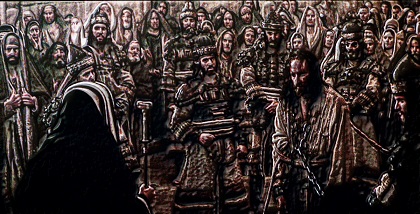
✦ Excerpt from Mark 14:53-65 (similar accounts in Matthew 26:57-68, Luke 22:54-65, and John 18:19-24):
53And they led Jesus to the high priest; and all of the chief priests and the elders and the scribes
were assembled. 55Now the chief priests and the whole council sought testimony against Jesus to put him to death.
63And the high priest tore his mantle, and said, “Why do we still need witnesses? 64You have heard his
blasphemy. What is your decision?” And they all condemned him as deserving death. 65And some began to spit on him, and to
cover his face, and to strike him, saying to him, “Prophesy!” And the guards received him with blows.
✦ The above would have been based on Jewish testimony.
✦ The only documented conflict to Roman support of the Jesus movement are written accounts that Jesus was struck with a reed
while in Roman custody:
Matthew 27:27-31 states:
Then the soldiers of the governor took Jesus into the praetorium, and they gathered the whole battalion before
him. And they stripped him and put a scarlet robe upon him, and plaiting a crown of thorns they put it on his head, and put a reed in
his right hand. And kneeling before him they mocked him, saying, “Hail, King of the Jews!” And they spat upon him, and took the reed
and struck him on the head. And when they had mocked him, they stripped him of the robe, and put his own clothes on him, and led him
away to crucify him.
✦ Five important points regarding the above excerpt:
- The event took place in the Roman praetorium and would have been based strictly on Roman witness, the
very ones who would have been involved in promoting deception. Jews very rarely entered Roman buildings (considered defiled).
John 18:28 even records that the Jews did not enter the praetorium on that day.
- The spitting and mocking have remarkable similarity to the description in the Jewish court.
- In Luke this event did not involve Roman soldiers, but Jewish soldiers in Herod’s court. In Luke the Jewish
soldiers did not strike Jesus.
- The accounts in the Jewish court are in all four Gospels, and are more violent than the account in the Roman
praetorium. Being struck in the head with a reed is hardly the beating commonly portrayed in Christian folklore.
- The Christian folklore version of a violent beating by Roman soldiers conflicts significantly with
Pilate’s public defense of Jesus in front of the Jewish mob.
✦ The traditional word-of-mouth version of the “crown of thorns” in Christian folklore portrays long, menacing thorns tearing
into Jesus’ scalp causing great pain with blood streaming down his face.
- These are strictly word-of-mouth images since written documentation does not mention thorns piercing skin,
the blood they may have caused, or the pain they may have inflicted.
- The Gospels refer to Roman soldiers “plaiting a crown of thorns.” The word plait means to braid, as in
hair or straw, which suggests a softer weave of some flexible stalk.
|
|

